European Literacy Coalition launches with the Warsaw Memorandum
The European Commission will launch the European Literacy Coalition in a two-day event on 22 and 23 September in Brussels, bringing together educators, researchers, publishers, writers and illustrators, librarians and booksellers, and experts from culture, health, technology and civil society. The Coalition will provide a platform to strengthen cooperation and improve literacy skills across Europe.
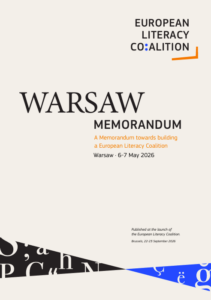
The launch event will also present the Warsaw Memorandum, the Coalition’s founding text. Developed by stakeholders from across Europe, the Memorandum sets out a shared understanding of literacy, identifies key barriers across the course of life and outlines the first steps for the Coalition’s long-term, cross-sector work. It is an open invitation to stakeholders to endorse its principles and contribute to the Coalition.
“The Warsaw Memorandum is an important step towards a shared European understanding of literacy. Literacy challenges may vary across countries, but they are united by the same fundamental question: how do we ensure that people have the capacity to learn, participate and evaluate information in a rapidly changing world?” says Emmi Jäkkö, Executive Director at the Finnish Reading Center.
Literacy faces new challenges
Literacy is a foundation for learning, participation, and resilience in a rapidly changing Europe. Digital developments, including artificial intelligence, are reshaping how people read, write, and engage with information, while creating new challenges linked to misinformation and disinformation, attention and wellbeing. Migration and multilingualism are also contributing to increasingly diverse literacy needs.
The initiative comes at a time of persistent literacy challenges. OECD PISA 2025 results show that 31.3% of 15-year-olds in the EU struggle to understand basic text. The OECD Survey of Adult Skills 2023 found that more than one in four adults have low literacy proficiency.
“It is significant that literacy is increasingly being recognised across Europe as a whole-of-society issue. Strengthening literacy is not only a task for schools or the cultural sector. It requires cooperation between education, libraries, the third sector, healthcare, businesses and policymakers,” Jäkkö says.
A shared European platform for advancing literacy
Launched under the Union of Skills and the Action Plan on Basic Skills, the Coalition will complement existing literacy and reading-promotion organisations and networks, creating a common space to share expertise, identify shared priorities and strengthen cooperation across sectors and European policy areas.
The two-day launch will explore literacy as a public good and shared responsibility, with workshops helping to shape the Coalition’s future work.
“Europe needs shared solutions to strengthen literacy, but we also need to learn from one another. Finland has a long tradition of cooperation between schools, libraries, civil society organisations and the publishing sector, and there is growing interest in these models across Europe,” Jäkkö says.